
Core insights – Cross-sectional systems integration for drug repurposing
Welcome to REPO4EU: Core insights
Our brand new article series where we bring you closer to our project's core innovations and results.
The strategic role of systems integration
A brief introduction
Why does systems integration play such a critical role in REPO4EU and the drug repurposing journey? Quite simply, it is the connecting tissue that ensures every specialized technology and mindset in the project fits together perfectly. By harmonizing diverse elements, we aim to create a comprehensive body of drug repurposing knowledge and workflows that can be seamlessly integrated into a unified Drug Repurposing Platform.
A foundational milestone in this process is the definition of Technology Readiness Levels (TRLs). These benchmarks allow comparisons among the development stages of otherwise disparate technologies. While bridging early scientific discovery with industrial feasibility is usually considered a challenge, establishing workflows to prioritize repurposing candidates can be the key to balance regulatory preparedness and patentability with reimbursement considerations and real‑world unmet medical needs. Ensuring CMC (Chemistry, Manufacturing, and Control) compliance is another essential pillar of our work. Here, specialized templates tailored to the unique regulatory requirements of drug repurposing help streamline the path toward clinical approval.
By connecting these elements, systems integration transforms a collection of standalone tools into a powerful, synchronized engine for drug repurposing acceleration.
The road so far
Scaling technology readiness, AI-powered intelligence and prioritization
At the project’s inception, we established a baseline TRL inventory to map the critical technologies available within the consortium. We have since taken this exercise a step further by projecting the specific TRL requirements needed to meet the platform’s rigorous standards. By extrapolating these interactions, we ensure that every technical component is seamlessly aligned with the platform’s final architecture.
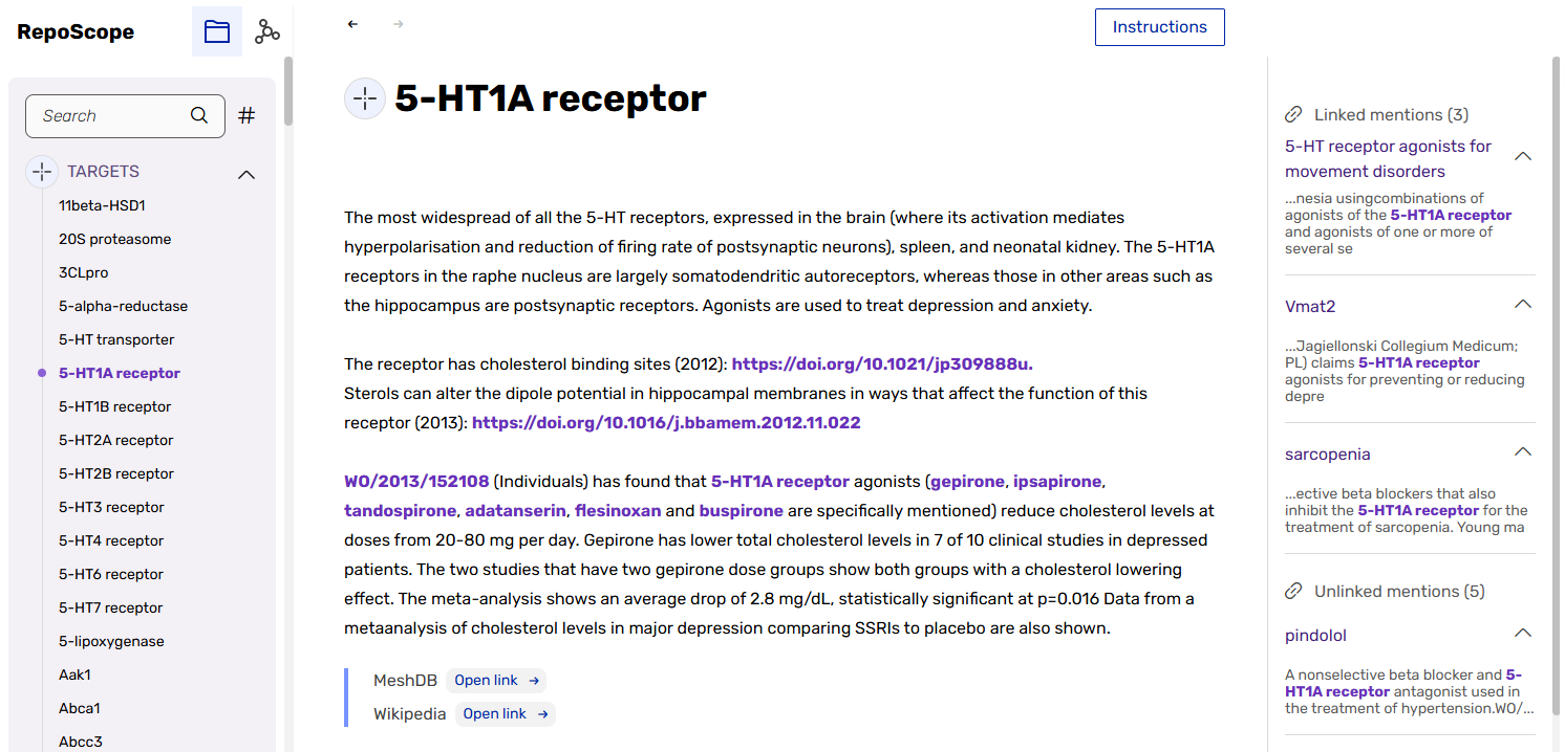
A major milestone has been the provisional integration of the hugely expanded version of the RepoScope knowledge base into the platform’s alpha version, with full integration slated for the beta release.
RepoScope is a database of patents, peer-reviewed papers, conference abstracts, and other scientific information related to drug repurposing. Within the REPO4EU drug repurposing framework, RepoScope serves as a prior art filter for prioritising candidate compounds, enabling users to make educated go/no-go project decisions in a pre-project stage based on what the scientific community has already published, and facilitating freedom-to-operate analyses and strategic patenting considerations.
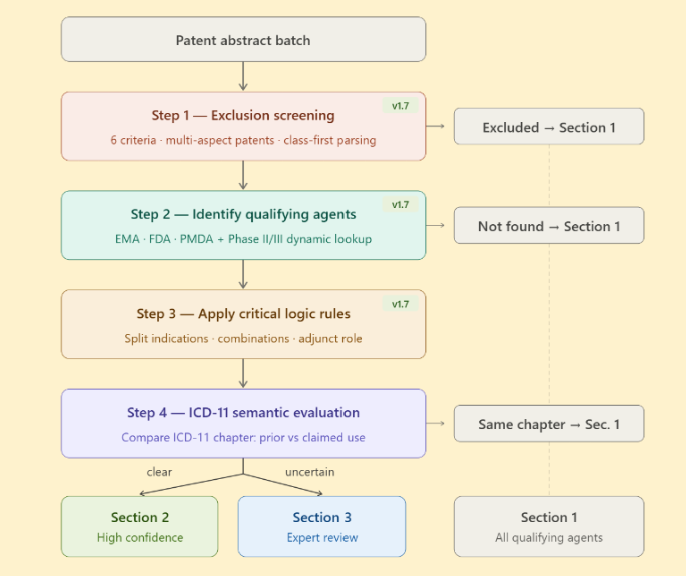
By early 2026, we solved a significant bottleneck: the overwhelming task of manually screening 300–500 life science patent applications per week. This is now handled by RepoDetect, an internal LLM-based screening tool that automates the process with such precision that only a few borderline cases require human review. This advancement ensures the long-term sustainability of RepoScope. Looking ahead, we are training RepoDetect to identify peer-review companion papers, i.e., journal articles already published by the inventors that elaborate on the subject of identified drug repurposing patent applications.
Additionally, meaningful work has been conducted towards building a Unified Prioritization Matrix. One may think of this as a multidimensional decision tree including :
- Multiple “Roots” (Entry Points) defined by the user’s specific repurposing strategy.
- A set of “Common Pathways” for development.
- “Branches” (Exit Points) tailored to the chosen objectives of the drug repurposing project.
To illustrate this in practice, we are developing fictional drug repurposing scenarios that demonstrate how the matrix steers a project from a scientific concept to a viable medical solution.
Looking ahead
Shaping a scalable and responsive infrastructure
Our guiding vision is to architect a scalable, responsive infrastructure that supports EU-wide health readiness and bridges the gap between laboratory discovery and patient care.
As artificial intelligence (AI) continues its rapid evolution, our role is to keep the REPO4EU Platform, the central hub of our drug repurposing infrastructure, at the absolute cutting edge of integrated technology. Because we aren’t just building a static tool; we are cultivating a living ecosystem that adapts to the shifting pulse of modern medicine and technology. Our next milestone is to develop advanced AI support on establishing links to the peer-reviewed paper sphere of drug repurposing.
However, this forward-looking mission is not without its hurdles. While AI has automated much of our screening, the scientifically meaningful abstraction of identified repurposing patent documents and the precise tagging of named entities remains a challenge. Therefore, building a comprehensive knowledge graph of the repurposing patentome requires moving beyond the RepoDetect approach.
As the project’s connective tissue, systems integration demands continuous monitoring of both internal progress and global developments across relevant fields. There is no shortcut for this level of vigilance. It is a fundamental requirement that is as demanding as it is rewarding. Through this ongoing integration effort, we ensure the transformation of fragmented research into a unified, future-proofed engine for drug repurposing.
Behind the scenes
Meet our team of experts
The systems integration pillar is led by HMPC, who is dedicated to bridging the gap between high-level research and clinical readiness. Their work is pivotal in assessing TRLs, developing robust prioritization matrices, and establishing gold-standard CMC documentation guidelines. Beyond technical frameworks, this ensures the project’s resilience by integrating the REPO4EU platform into broader EU health emergency preparedness plans.
With over 25 years of experience spanning both academic research and the corporate pharmaceutical industry, HMPC provides a sophisticated, big-picture perspective. Working closely with the Egnosis and ScienceOpen teams, its leadership ensures an overarching provision of tools and services that harmonizes contributions from our multidisciplinary team of experts, all converging toward a single goal: accelerating drug repurposing.
About our platform
Discover our platform and explore its key features
Become an early tester now!
Follow the link to sign up for our platform's alpha release


Behind the REPO4EU Platform: In conversation with Harald Schmidt (Maastricht University)
Harald Schmidt is a renowned physician, pharmacist and scientific strategist and is one of the leading voices in systems medicine and precision diagnostics. He’s a professor emeritus at Maastricht University, where he acted as a chair of the pharmacology department, and he’s the author of ‘The end of medicine as we know it – and why your health has a future’, where he proposes concrete steps to completely redesign our perception of diseases and how they are treated.
Harald is also a known advocate for mechanism based drug repurposing, a topic he has brought to the forefront of global discussions on medicine and pharmacology as a project coordinator for REPO4EU, the EU-funded initiative that aims to demonstrate Europe’s role as the leader of repurposing efforts amongst the drug innovation arena. In this interview, Harald discusses the ambition behind REPO4EU to build a platform for the global drug repurposing community and how these efforts have the potential to change the future of medicine.
The mission fuelling REPO4EU
Harald, as the coordinator of REPO4EU, can you explain what the core goal of the project is?
Technically, REPO4EU is the response to a funding call from the European Commission to foster drug repurposing across Europe.
Drug repurposing means that instead of developing entirely new drugs, we use medicines that are already on the market and find new uses for them. This has been happening for decades, but usually quite serendipitously; our goal is to make this process much more precise and systematic.
The real innovation of REPO4EU is in how we approach this. We want to fundamentally redefine what we currently call a disease. Most diseases today — except for infectious diseases or some rare diseases caused by a single gene — are defined simply by describing a symptom in an organ. Hypertension, asthma, psoriasis, inflammatory bowel syndrome… these sound like precise disease definitions, but they are really just descriptions of symptoms.
As a result, many therapies are imprecise. Not every patient taking the same medication will experience the same benefit, and this also contributes to the high failure rate in drug discovery.
What we introduce instead are predominantly genetically defined disease definitions, more similar to how rare diseases are approached. This allows us to identify much more precise treatment strategies and opens enormous potential for repurposing existing drugs — not only for their original target, but for completely different disease mechanisms.
Because these drugs are already approved, we already know most of their side effects, and we can skip long discovery and preclinical development stages. That means the process is faster, cheaper, and often much more efficient.
What does coordinating such a large initiative actually involve?
Operationally, my role as a coordinator is making sure this unusually large project — with 27 partners and a €25 million budget — moves in the right direction and that all the different pieces come together successfully.
The real advantage of having such a large consortium is that it allows us to bring together the best people across Europe. What we are doing goes far beyond the initial scientific discovery.
In medicine, we currently face what is often called the “valley of death” — a huge gap between basic research and actual patient benefit. We produce enormous amounts of academic research, but very little of it reaches patients in the form of better diagnostics, therapies or prevention strategies. One major reason is that academic success is still measured mostly by publications and grant income, not by whether your work improves patient outcomes.
REPO4EU tries to bridge that gap. We make sure that from the very beginning, researchers are thinking not only about scientific discovery, but also about patents, regulation, clinical validation, market access and reimbursement. We want researchers to think early about whether their discovery can realistically become something that benefits patients.
That requires bringing together experts from many different areas — science, ethics, regulation, business, intellectual property and healthcare systems. No single person can solve this alone.
Building a one-stop shop for the drug repurposing community
One of the core outputs of the project is the REPO4EU platform. Why is this platform needed, and what makes it so important?
The REPO4EU platform exists because we believe what we are doing will shape the future of medicine.
Rather than waiting for our clinical results to slowly spread through the academic world, we wanted to provide all the tools, guidelines and workflows directly to researchers so they can apply these methods themselves.
One of our biggest achievements is in bioinformatics. Traditionally, to work with bioinformatics, you needed to be a bioinformatician — someone who could code and use highly specialised software. We wanted to create something that the average biomedical scientist could use without needing that expertise. That required a lot of work because bioinformaticians and biomedical scientists often speak almost different languages.
We now have a very strong tool called drugst.one that makes this possible. Instead of generating a long list of 100 possible drug candidates, we aim for extreme precision — ideally narrowing it down to just two or three highly relevant options.
Beyond that, the platform integrates everything needed for the full translational process: preclinical validation, access to human cell models, clinical trial design, patent strategy, regulatory guidance, reimbursement planning and health technology assessment. It’s not just a collection of links or tools — it’s a fully integrated online workspace that guides researchers through the entire journey from idea to patient impact. And importantly, it can be used globally, not just in Europe.
Why is an interdisciplinary approach needed to develop this platform?
Nobody in this project works in isolation. You cannot simply sit in your office, do some bioinformatics, and hand the results over to someone else. The process is highly iterative and requires constant dialogue between teams.
For example, after bioinformatics predictions are made, we immediately need discussions around preclinical validation. Can we validate using human cell models? Do we need animal models? Is it safe enough to move directly into clinical trials?
At the same time, we apply an ethics by design approach. We do not want ethics to be something that is considered at the very end, just before a clinical trial starts. Ethics should be part of the process from day one. The very first question should be: is there really an unmet patient need? Does this approach genuinely benefit patients? Are the risks acceptable? If the answer is no, then there is no reason to continue with further experiments.
Likewise, patent strategy and commercial viability must be considered early. If something cannot realistically be developed into a therapy, then even excellent scientific results may end up as a translational dead end.
Everything we do is built around one central goal: not papers, but patients.
Looking ahead — enhancing the platform’s capabilities
The beta version of the platform will be released in the autumn of 2026. What do you expect from this milestone?
Two things. First, that the platform truly works — that it can reliably guide discoveries toward real patient impact; and second, that it is widely used by scientists, clinicians, biotech companies and industry partners.
The goal is scale. We want to accelerate innovation in diagnosis, treatment and prevention as quickly as possible.
Drug repurposing is only one part of this. Precision prevention is another major area. If we can better define disease risk, we can also provide much more personalised prevention strategies, reducing the need for treatment later on. In many cases, lifestyle interventions may be enough if they are tailored precisely enough. Only in a smaller percentage of cases would drugs be needed. So this is really a broader shift toward precision medicine as a whole.
Right now, we are preparing both alpha and beta testing phases of the platform, and feedback is incredibly important. We invite researchers, clinicians and other stakeholders to register via this link, so they can test the platform and tell us what works and what needs improvement.
Finally, who do you envision will be using the platform once it is fully launched?
A very broad range of stakeholders!
Bioinformaticians may want to better understand what happens after the computational predictions. Biomedical scientists can use the tools directly. Biotech companies, pharmaceutical companies, regulators, health technology assessors — they all have a role to play.
Even patient organisations are very important for us. While we do not make specific recommendations for individual patients, we absolutely want patient groups to engage with us and help shape the process.
I think everyone involved in healthcare innovation can benefit from looking a little outside their own silo and understanding how the whole system works. That is exactly what REPO4EU is trying to build.
REPO4EU: The Podcast
Our podcast brings listeners closer to the latest innovations, research and developments happening in drug repurposing across the globe. In the second season, ‘Platform Conversations’, we're exploring the process of building an online platform that will bring everything to do with drug repurposing under one roof — made in Europe with global reach. We will hear form the experts involved in making this ambition a reality.