
REPO4EU researchers launch SMART, the tool that simplifies decision models for healthcare innovation
Decision-analytic models play a vital role in healthcare, helping researchers, policymakers, and clinicians evaluate the cost-effectiveness and value of new interventions. Yet, building these models can be complex, especially in early-stage research or data-limited contexts such as drug repurposing or rare diseases.
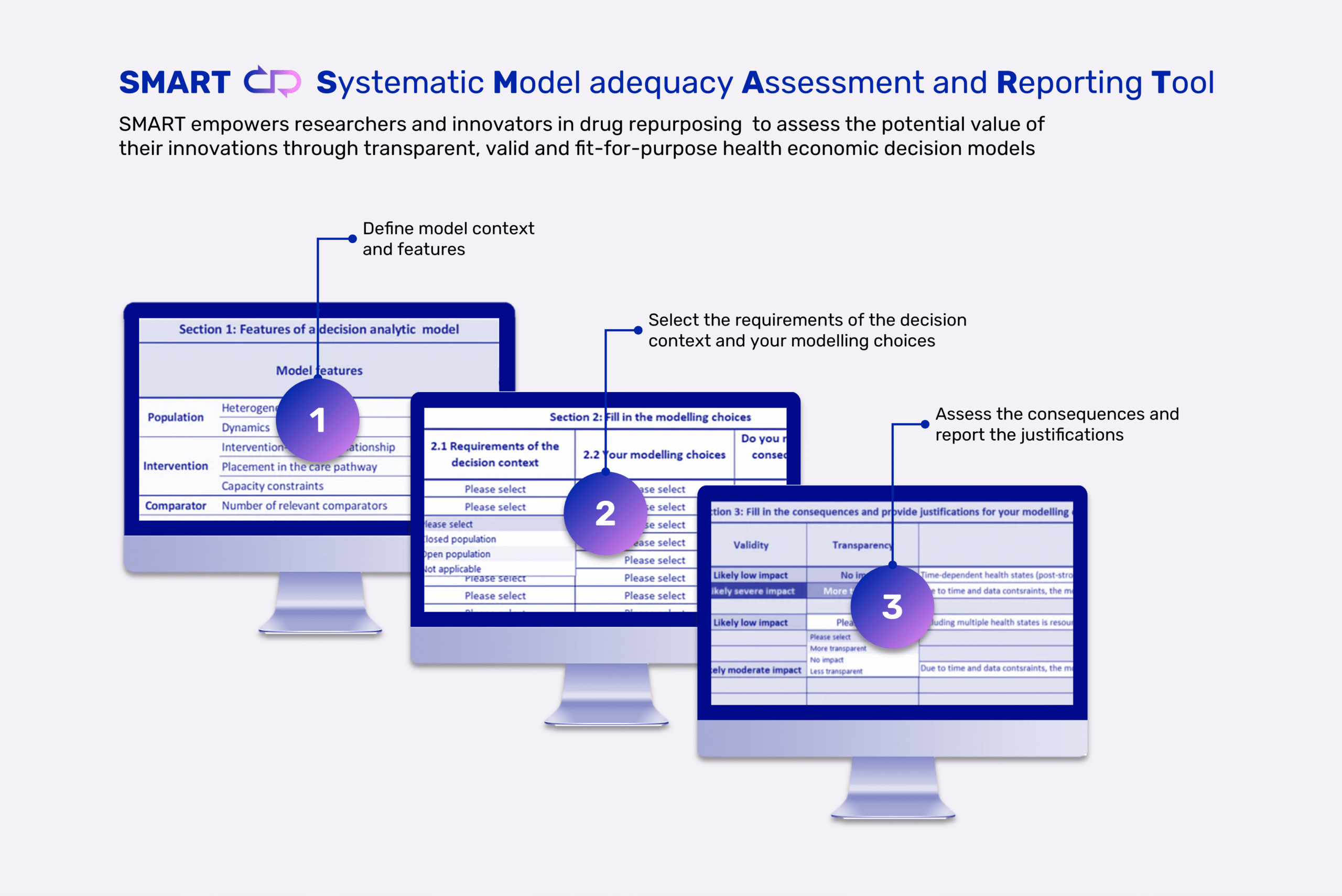
To address this challenge, researchers in the REPO4EU consortium have developed SMART, a structured, step-by-step tool designed to guide users through making, reporting, and justifying simplified modelling choices tailored to specific decision contexts.
Teebah Abu-Zahra, Health Economics Researcher at Maastricht UMC+, led the development of the tool alongside other colleagues involved in REPO4EU. In this interview, she explains the motivation behind SMART, how it can support innovators and decision-makers, and what role it plays in advancing drug repurposing and precision medicine.
Hi Teebah! Can you tell us, in a few words, what is SMART?
SMART is a practical tool built to guide researchers through the process of making, reporting, and justifying simplified healthcare modelling choices, in a step-by-step structured framework. It helps users understand the trade-offs between the model’s simplicity, and its transparency and validity in each model feature. Overall, SMART promotes fit-for-purpose modelling that is appropriate for the specific decision context and the constraints that come with it.
What prompted the need to create this tool?
In short, SMART was born out of the need to make decision models more accessible, more transparent, and more useful for those who need it most, especially when time and data are in short supply.
When we first started this work, our goal was to develop practical guidance for researchers who aren't health economics experts but still need to use decision-analytic models to inform important healthcare decisions.
We were thinking not only of scientists and innovators working on drug repurposing research in academic settings or SMES, but of anyone who, despite having limited time, data or technical expertise, still needs to assess the value of their healthcare innovation.
Why is this important within a healthcare innovation context?
There is currently no clear accessible guidance tailored to developing decision models in contexts such as designing an early-stage intervention, testing a repurposed drug, or working in a resource-constrained setting.
Decision-analytic models are powerful tools in health economics, used to compare healthcare interventions based on their potential cost-effectiveness. They support decisions at all stages of development, from research prioritization to pricing and reimbursement. But building these models isn’t straightforward.
As we looked through the existing literature and resources, we saw a growing gap in supporting decision models development in contexts where simplicity isn’t just a preference, but a necessity.
Think, for example, of precision mechanism-based drug repurposing, where hundreds of drug-indication pairs need to be screened for potential value, often without clinical or cost data. Or rare diseases and health system planning in low- and middle-income countries, where timelines are tight and data is sparse. In these scenarios, simple early-stage models can provide immense value, by highlighting unmet medical needs, estimating societal value and guiding early pricing discussions.
Who are the end users of SMART?
We believe SMART will be valuable to a wide range of users — from health economic decision modellers all the way to regulatory bodies, health technology assessment agencies, peer reviewers, policymakers, clinicians, and even other healthcare decision makers.
Apart from enabling reviewers and users to better assess whether a model is suitable to inform healthcare decisions, we also see value in using SMART as a training and educational tool for non-experts in health economic decision modelling, including scientists, innovators and public health professionals.
Now that it’s been officially released, we’re excited to see how SMART will be applied in real-world settings to support more transparent, efficient and fit-for-purpose modelling.
How has it been received by the healthcare community so far? Have you had any feedback from peers who have used the tool yet?
Yes! One of my colleagues is already using SMART in her own modelling research paper. She’s conducting an early value assessment (EVA) to evaluate the potential cost-effectiveness of seven digital technologies in addition to standard care in the United Kingdom; she said she found SMART very helpful to ensure transparent reporting and justification of the simple modelling choices.
We are also currently applying SMART in a REPO4EU pilot study involving patients with thyroid cancer. We can already see the value of our tool in guiding the development of a health economic decision model within a context of limited data and urgent need for new therapeutic options, as seen in patients with anaplastic thyroid cancer and poorly differentiated thyroid cancer.
What was your role in the development of SMART? And who else was involved in the process?
I developed SMART from its initial concept through to design and implementation, with the continuous support and guidance from Manuela Joore and Sabine Grimm, both also from Maastricht UMC+. My primary responsibilities included identifying gaps in existing health economic modelling guidance, shaping the framework and content of the tool and conducting interviews and workshops to help guide the SMART development.
The whole process also benefited from the contributions of Mirre Scholte from Radboud UMC and others from the REPO4EU consortium, including Prof. Joe Loscalzo and Adam Raymakers from Harvard Medical School. Together we identified key features of health economic decision models based on reviewing key literature, established guidelines, and our collective expertise.
To facilitate consistent use of SMART, we also developed a glossary and applied the tool in an illustrative case for planning a health economic decision model for a repurposed drug for treatment-resistant hypertension.
While the core development was conducted at KEMTA (the Clinical Epidemiology & Medical Technology Assessment at Maastricht UMC+) we also obtained extensive feedback through in-depth interviews and expert workshops with health economic decision modellers and model users, which helped us massively in refining the tool and inform key development decisions.
How will SMART contribute towards the development of the REPO4EU Platform and the overall mission of the project?
With the support of the Egnosis team, SMART will be integrated into the REPO4EU Platform to make it directly accessible to researchers and innovators engaged in drug repurposing research.
With the help of SMART, alongside other essential HTA resources on the platform, we aim to empower these researchers to develop health economic decision models to assess the value of their innovations independently and efficiently. This, in turn, promotes a more transparent and systematic approach to health economic evaluation in mechanism-based drug repurposing and precision medicine development, ultimately supporting improved decision-making and resource allocation for developing new therapeutic options that address unmet patient needs.
The SMART tool
Can we make health economic decision models as simple as possible, but not simpler?
Sounds interesting?
Follow the link to access version 1.0 of the SMART tool


Drug Repurposing Next-Gen: Interview with Filipa Lopes (University of Porto)
Filipa Lopes is a specialist in Bioethics, with a background in Biology and Applied Microbiology. She’s currently pursuing her PhD as part of the Ethics team within REPO4EU, where she’s conducting rigorous ethical analysis to ensure all the activities carried by the partners in the project adhere to the highest ethical standards — from animal welfare to patient data protection. In this interview, Filipa shares her journey as a young bioethicist and reflects on the importance of conducting research responsibly.
The role of Bioethics in scientific research
Hi Filipa! Let’s start with the beginning of your scientific journey. What inspired you to pursue a career in science?
My journey started with a Bachelor's in Biology at the University of Porto, followed by a Master's in Applied Microbiology at the Catholic University of Portugal. It was during my master's thesis, where I explored the bioethics of genome editing, that I discovered my passion for bioethics. That interest led me to pursue further specialisation, including a post-graduate degree in animal welfare. Professionally, I worked in evidence-based veterinary medicine before joining REPO4EU as a research fellow focused on ethics. I've also taken courses in clinical and research ethics, which further shaped my perspective.
For those unfamiliar with the term, can you explain what bioethics is and why it's important?
Bioethics is, in short, the way to do science with rules and values. It provides researchers with principles and guidelines that help ensure their work is done responsibly. In the rush to publish or innovate, some might overlook ethical considerations, and that’s where bioethics steps in — to define boundaries, safeguard participants and protect the integrity of research.
And when it comes to powerful technologies like genome editing or AI, what are the key ethical concerns?
Technologies like CRISPR-Cas9 are revolutionary but also raise serious ethical questions. While they offer incredible opportunities, they can also be misused, even for things like bioterrorism. We must apply a precautionary principle — thinking through consequences, risks and societal implications before using such tools, especially in humans.
In the case of Artificial Intelligence, this is still a new world for many of us, and its ethical implications are vast. Issues like bias, transparency, and accountability need careful attention. We're still learning how to navigate this space, but our goal as bioethicists is to ensure that new tools are used responsibly.
You mentioned you did a post-graduate course in animal welfare. What attracted you about this area specifically?
Animal welfare is essential in clinical research. In Europe we have to follow very strict rules and adhere to the 3Rs: Replacement, Reduction and Refinement. This means we always strive to minimise animal use, improve their living conditions and replace them when alternatives exist. I’m very passionate about this subject because I do understand that, in some instances, it is necessary to use animals for research because it’s for a huge end — for example, for clinical trials for cancer — but we must do so respectfully and ethically, always.
Developing an ethics-by-design framework for REPO4EU
Let’s talk about your work in the REPO4EU project. What is your role within this European consortium?
I’m currently pursuing my PhD within the ethics team at REPO4EU. We take an ethics-by-design approach to create tools like ethics self-assessment templates for all work packages, helping researchers in the project identify and address ethical issues from the start. We also develop information sheets and consent forms tailored for clinical trials, organise training on research ethics and open science, and ensure compliance across sensitive topics such as data privacy, use of human tissue, animal welfare and the integration of AI.
You mentioned open science and research integrity, how do these two fit in?
Research integrity deals with values and norms that distinguish acceptable from unacceptable scientific behavior, while research ethics applies foundational principles to protect participants and ensure transparency. Open science, in turn, promotes inclusiveness and democratic access to knowledge. Together, they create a framework for ethical, responsible and impactful research.
Have you encountered any challenges in getting researchers to adhere to this ethical framework?
Thankfully, no. Most researchers involved in REPO4EU already had a strong understanding of the importance of ethics. The biggest challenge we face is staying updated with everything happening across such a large, multidisciplinary project; it takes time to connect with all work packages and ensure alignment, but it's essential for applying our ethics-by-design framework effectively.
And what has it been like working with such a diverse, transdisciplinary team?
It’s both exciting and complex. Each REPO4EU partner brings a different expertise and degree of knowledge across AI, clinical trials, legal frameworks… as bioethicists, we need to understand enough of each field to offer meaningful ethical guidance; this means constantly learning and adapting. But I really enjoy this aspect of my work, it's one of the most enriching parts of the project.
Advice for young scientists and future researchers
What’s one key message you’d like other researchers to take from our conversation?
Be a responsible researcher. Embrace integrity, curiosity, honesty and resilience — and above all, respect science and the people involved in it. It's not just about the results, but about how we get there. Ethics, values and norms should guide everything we do.
And, drawing from your own journey and experiences, what advice would you give to a young person thinking of pursuing a scientific career?
Follow what makes you happy. Science isn’t easy, especially in countries like Portugal where funding is limited, but if it’s your passion, go for it! Be aware of the challenges, but don’t let them stop you. Resilience and love for what you do will carry you forward.
REPO4EU: The Podcast
Our podcast brings listeners closer to the latest innovations, research and developments happening in drug repurposing across the globe. The first season, ‘Drug Repurposing Next-Gen’, spotlights the work of PhD researchers, post-docs and young investigators involved in REPO4EU, exploring their role in the project as well as their career journeys. New episodes will be released monthly. Stay tuned for the next one!